
Your website describes you. What about the visitor?
A website that looks tidy from inside the organisation can turn into a puzzle for someone coming from outside. Here we explain what information architecture is and where the problem appears.
- AREA
- Product and experience
- WHO IT IS FOR
- Universities, public bodies, holding companies and organisations with multiple units
- NEXT STEP
- Maturity assessment
- 1Rector's office
- 2Faculties
- 3Institutes
- 4Directorates
- 5Coordination offices
- 1I am a prospective student
- 2I am a student
- 3I am a graduate
- 4I am an academic
- 5I am a supplier
Drawn from an example university website. The same holds for public institutions and holding companies.
The website built around the organisation chart.
On your organisation's website every unit has a page and the menu is almost a copy of the organisation chart. For someone who works there everything is in its place. A visitor from outside cannot find the information they want, because they do not know which unit it belongs to.
What is information architecture?
Information architecture is the structure that determines how the content of a website or product is grouped, how it is named and by which route the user reaches it. The menu, categories, order of pages and search are the visible part of this structure. What a floor plan is to a building, information architecture is to a website.
Where does the problem appear?
Universities, public institutions, holding companies and multi-unit companies serve very different visitors. A prospective student, a graduate, an academic and a supplier come to the same website with different questions. When the site is arranged by unit, all of these visitors first have to learn the organisation's internal structure. A well-built structure starts from the visitor's question.
- MENU
How the content is grouped
- CATEGORIES
How the groups are named
- PAGE ORDER
By which route it is reached
- SEARCH
How someone who does not know the route finds it
Information architecture is to a website what a floor plan is to a building.
What does it cost you?
Phone calls for information and applications sent to the wrong unit increase. However rich your content is, because it cannot be found it is as if it did not exist.
You do not have to rewrite the content.
In most organisations the content is sufficient. What needs to change is not the content itself but how it is grouped and under which name it is presented.
Where does your website stand?
The assessment has a topic called information architecture and priority. There you will see whether your site structure has been tested with visitors and what decisions are based on.
From our work.
Çevre ve Şehircilik Bakanlığı Web Sitesi
Finding what you need without knowing the organisation's structure
The ministry's website served very different audiences, from citizens to sector professionals and from local government to the press; because a large number of units, documents and services sat in the same structure, reaching the right information was hard. We reorganised the content around the user's need, not the organisation's structure. A visitor can find the service they want without knowing which unit to go to.
View project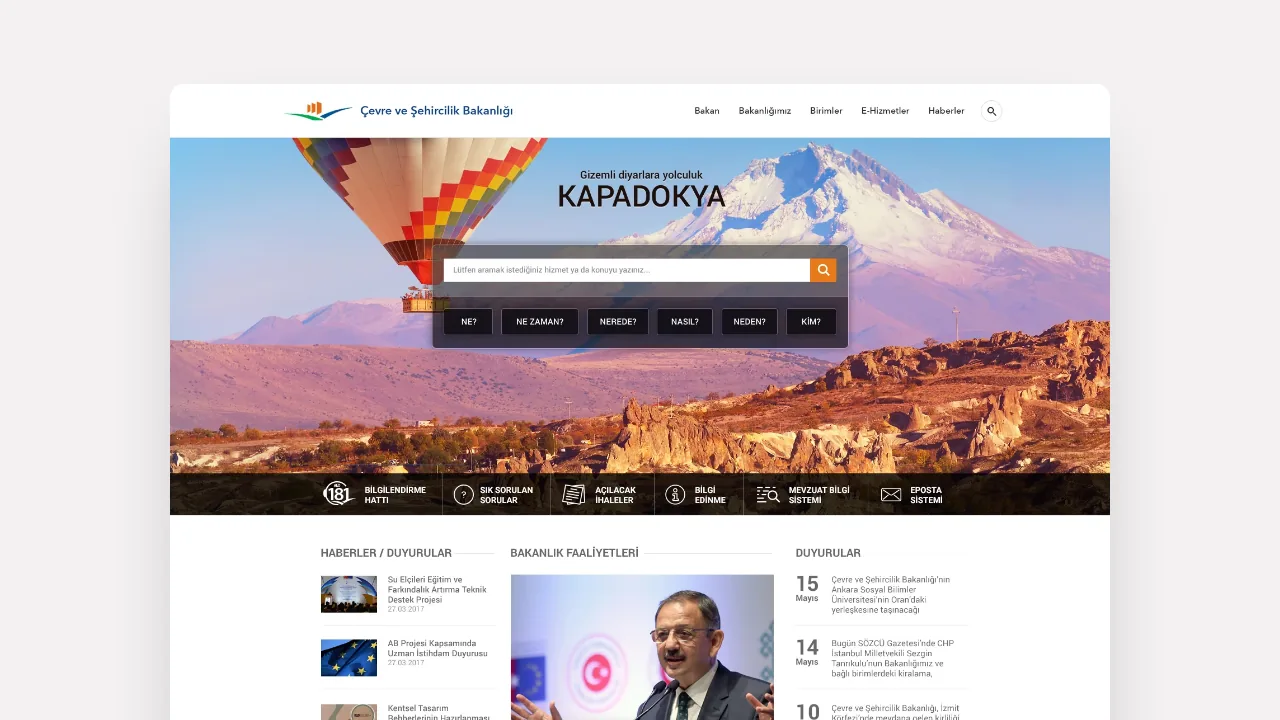
Related topics.
- They came this far. Why did they leave?Why carts and application forms are abandoned and which steps to improve.
- The queue starts on the screen, not at the till.How screen design in checkout and operations software determines transaction time.
- One product, more than one user.What should be shared and what should be designed separately on multi-sided platforms.
- What is a user journey map, and how do you create one?
Your website describes you. What about the visitor?
Assess your website