
They came this far. Why did they leave?
Persuading the customer and losing them at the last step is the most expensive loss. Here we explain why baskets and forms are left halfway and which steps need fixing.
- AREA
- Product and experience
- WHO IT IS FOR
- Sites with a basket, an application or a membership form
- NEXT STEP
- Focus audit
- 01Added to basket
- 02Started entering their details
- 03Moved on to the payment step
- 04Completed the order
This rate never reaches zero. What matters is seeing where and why someone who did not intend to leave gives up. The rates in the diagram are illustrative.
The form left halfway.
The customer found the product, liked it and added it to the basket. Or they opened the application form and filled in the first steps. Then they left. You managed the hardest part, persuading them, but you lose the customer at the last step.
What is the basket abandonment rate?
It is the share of visitors who add a product to the basket and leave without completing the order. The same logic applies to application, quote and membership forms, that is you look at how many of those who start go on to finish. This rate is never zero, because some visitors have come only to look. What matters is understanding why someone who had no intention of giving up gave up.
Why is it left halfway?
Mostly because the form feels heavy. More information is requested than necessary, it is not clear why the questions are asked and it is not clear how long the process will take. When an unexpected charge, compulsory membership or an error message that does not say what is wrong comes on top of these, the person gives up. When a form starts to feel like filling in a survey, people leave.
A good form asks only for what is necessary, does not ask again for what it already knows, and shows the person which step they are on and what is left.
A good form does not ask again for what it already knows and shows the person which step they are on.
What does it cost you?
This loss is more expensive than the others, because you have already made all the spending needed to bring that person this far. A small improvement at the last step usually costs less than bringing more visitors to the site.
You do not have to rebuild the site.
The problem is in a single flow, and that flow can be fixed without touching the rest of the site.
At which step do you lose them?
The focus audit exists for exactly this. We review a single flow step by step and give you where and why you lose the customer, in order of priority.
From our work.
HappyTail
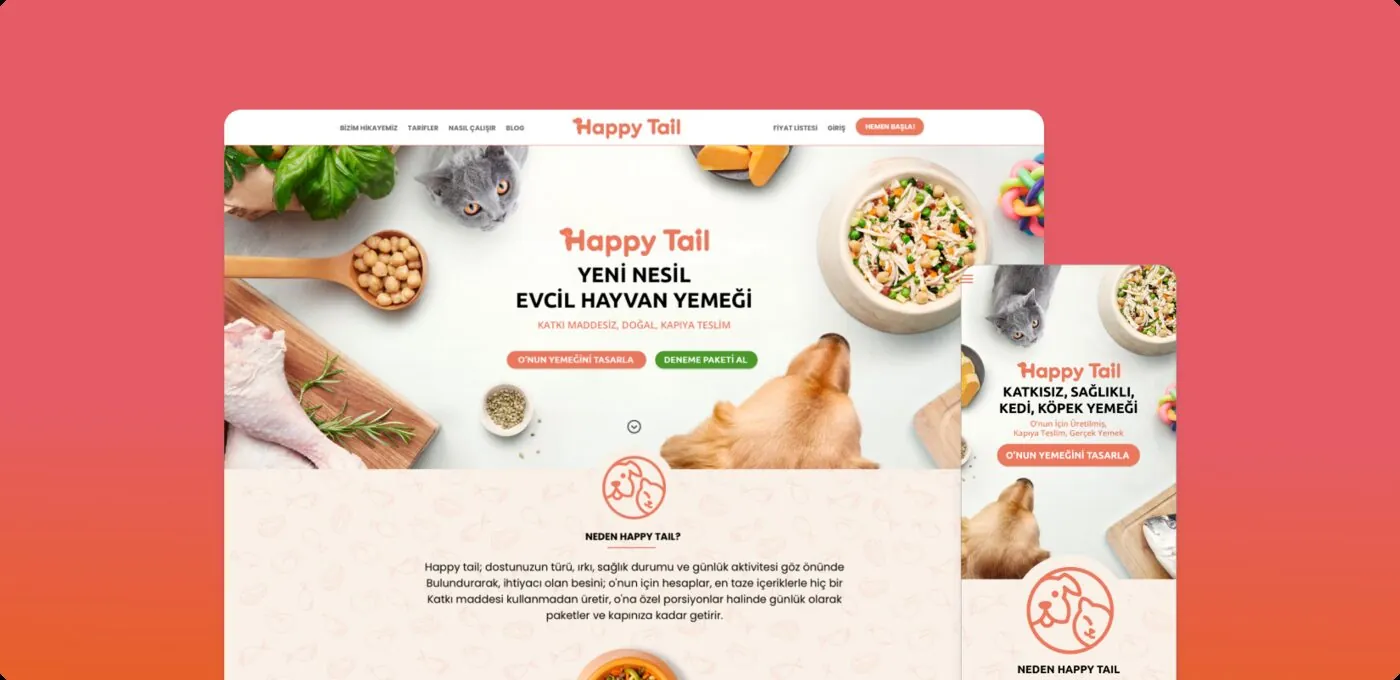
Splitting an order that asks for a lot of information into steps
At HappyTail the order is shaped by the pet's age, weight, activity level and health information; the challenge was to make this multi-variable structure easy for the customer to understand. We split data entry into steps and focused on a single group of information at each step. We have been working together for about ten years; the platform keeps developing as needs change.
View project
Related topics.
- Designed at a desk, used in the field.Is your field team not using the app? Why field sales and operations apps work at the desk and not in the field.
- You have an intranet. Does anyone use it?What sets an intranet and an employee app that people use apart.
- The queue starts on the screen, not at the till.How screen design in checkout and operations software determines transaction time.
They came this far. Why did they leave?
See the focus audit