
You build the software. Let's think through the interface together.
If your client looked at working software and did not like it, the problem is usually not in the software. Here we explain where the problem starts and how we work together with software companies.
- AREA
- Product and experience
- WHO IT IS FOR
- Companies that build software for their clients
- NEXT STEP
- Focus audit
- The software is written
- It is shown to the client
- "I don't like it"
- A limited fix that fits the existing structure
- Flows and screens are designed
- The client approves the screens
- Development builds knowing what it will build
- What is built is compared with the design
When design comes first, the scope becomes clear and there are fewer changes later.
Design support for software companies.
You are a software company. You won the project, built it and it works. At the handover meeting your client looked at the screens and did not like them. Or the work has not started yet, but you can already see that the client's design expectations are higher than your team can meet.
This happens often to good software companies too. The reason is not a shortcoming; design is a separate discipline.
Where does the problem start?
When the software team draws the interface, the screens are mostly shaped by the structure of the database, not by the user's task. Every field is there and every function works, but the user does not know where to start. This is usually what the client is trying to say with "I don't like it".
Design first, then development.
This is the right order. When design comes first, the software team knows what it will build, the scope becomes clear and later changes decrease. A designer called in after development is finished has to fit the existing structure, and what they can do is limited. We say this openly at the start, because in work we join late the expectation has to be set correctly.
- CLIENT
The client remains your client
- DESIGN
We set up the flows and design the screens
Handed over in a form the developer can implement directly.
- CHECK
We review the work during development
We work as the design side of your team.
How do we work?
The client remains your client. We work as the design side of your team: we set up the flows, design the screens and hand them over in a form the developer can implement directly. While development continues we also check whether what is built matches the design.
Not every project needs it.
For an internal admin screen with few users that can be solved with standard components, a separate design process is usually too much. As the number of users grows and the product moves closer to the client's shop window, design matters more.
Do you have finished work on your hands?
If you have a project you cannot hand over or one the client is not comfortable with, in a focus audit we review that project's most critical flow and tell you what needs to change, in order of priority.
From our work.
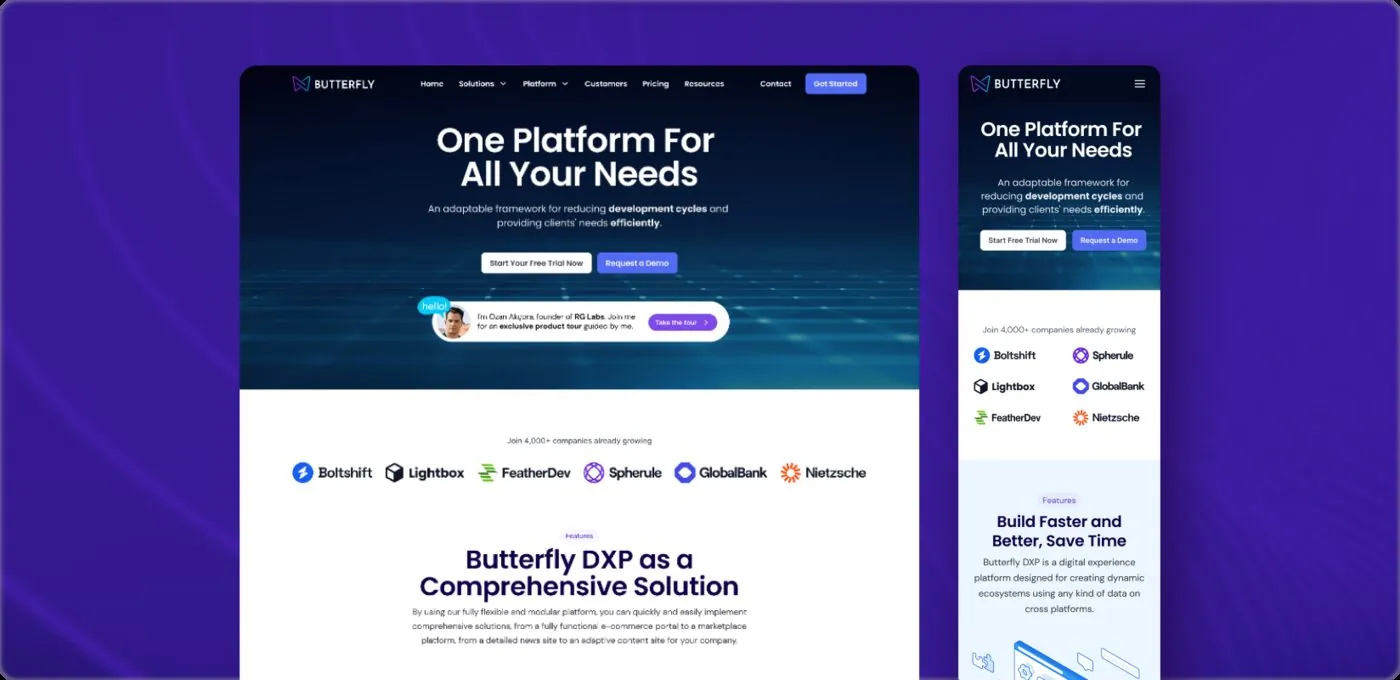
Butterfly DXP
Technically strong, hard to explain
Butterfly DXP, developed by RGLABS, was a broad platform ranging from headless CMS to e-commerce and order management. Instead of listing every feature at once, we built the content architecture on the idea of "one platform, many solutions"; the visitor sees the overall value first and then goes down to the technical depth they need. Trial and demo calls to action sit as the natural continuation of this narrative.
View project
Related topics.
- Your product is good. Does it look that way?How the interface affects sales and what to fix before going to market.
- It does everything. Nobody can find it.How to build a good dashboard and management panel.
- Your product is strong. Can your website explain it?Your product is strong, but your website cannot explain it. What a corporate and B2B website should be and what it should say first.
- Figma'dan çalışan ürüne geçerken tasarım nerede bozulur?
You build the software. Let's think through the interface together.
See the focus audit