
Your product is strong. Can your website explain it?
A website that cannot explain a strong product is something we see often. Here we explain what a corporate website should say first and why it fails to.
- AREA
- Product and experience
- WHO IT IS FOR
- Corporate and B2B companies
- NEXT STEP
- Maturity assessment
- FIRST QUESTION
What do you do?
- SECOND QUESTION
Who do you do it for?
- THIRD QUESTION
Why should they trust you?
- NEXT STEP
One clear next step
History, values and news belong as long as they support these three answers.
Strong product, a website that cannot explain it.
When you explain your product face to face, the person in front of you is convinced. A visitor to your website looks for a few seconds and leaves. Few demo requests arrive, and those who do come arrive without quite understanding what you do.
This is something we wrestle with on our own website too, so we will not tell you it is easy.
What should a corporate website have?
A visitor should be able to find the answers to three questions quickly: what you do, who you do it for and why they should trust you. After these three answers there should be one clear next step. Other content such as company history, values and news belongs there as long as it supports these three answers.
Why can't it explain?
Because the website is usually written looking out from inside the company. The people who make the product describe features, while the visitor is looking for the answer to their own problem. And when you try to fit every feature of a comprehensive product onto the first page, none of them gets across.
A good website needs content, design and search visibility to work together. When only one of them improves, the result barely changes.
- 1A list of all the features
- 2Modules and technical infrastructure
- 3Company history
- 4News and announcements
- 1Does it solve my problem?
- 2Who like me uses it?
- 3How do I start?
The people who make the product explain its features; visitors look for an answer to their own problem.
What does it cost you?
Because the website does no groundwork, your sales team starts every conversation from zero. Enquiries come from the wrong people, while the right buyer goes to your competitor without ever contacting you.
A new website is not a must.
The problem is usually not in the whole website. It is in the first screen of the home page and in the order in which the product page tells its story, and these can be fixed on the existing website.
Where does your website stand?
The assessment does not read your website's content. It looks at how its structure and main flows are managed, and from that you can tell whether the problem is a one-off or a lasting one.
From our work.
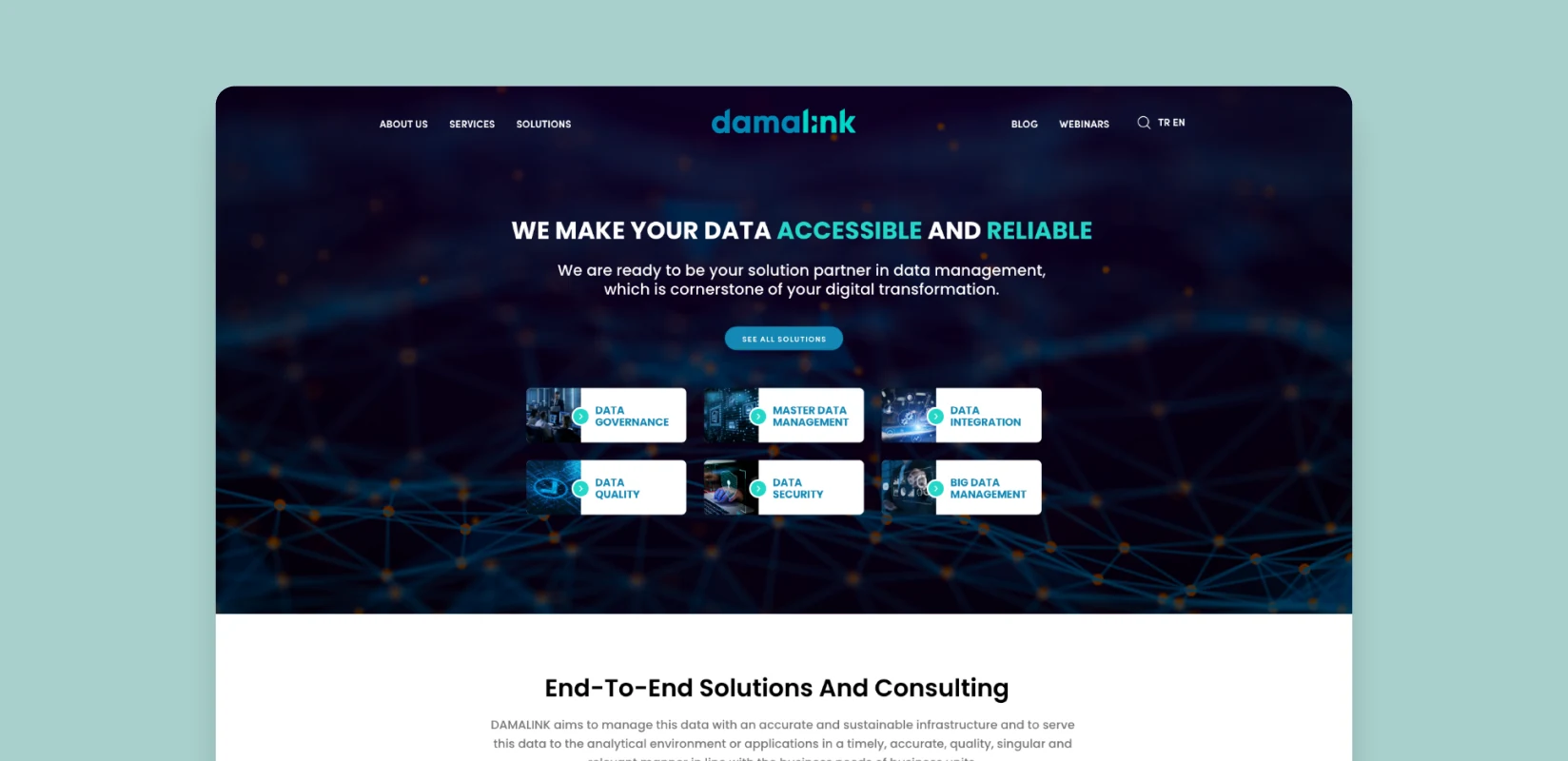
Damalink Kurumsal Web Sitesi
The expertise was there, the website could not explain it
Damalink worked across a wide field from master data management to data masking; the existing website could not convey this expertise in a consistent, easily understood story. We rebuilt the site structure around the company's core capabilities and rewrote the technical copy in terms of business need, problem and benefit. Success stories and references carry the trust side of the technical narrative.
View project
Related topics.
- You build the software. Let's think through the interface together.How we handle design in software companies' client projects.
- It does everything. Nobody can find it.How to build a good dashboard and management panel.
- The product is there. The customer cannot find it.How search, filters and catalogue structure shape e-commerce conversion.
- What should a good corporate website deliver today?
Your product is strong. Can your website explain it?
Assess your website