
It was good two years ago. What happened?
Even a well-designed product can fall apart within a few years. Here we explain why, what a design system is and what it solves. We call this design sustainability.
- AREA
- Product and experience
- WHO IT IS FOR
- Teams whose product is live and evolving
- NEXT STEP
- Maturity assessment
- LAUNCH DAY16 / 16
Every part comes from the same rule
- SIX MONTHS14 / 16
The first urgent additions
- ONE YEAR10 / 16
New team, new decisions
- TWO YEARS5 / 16
No rule is left
Nobody makes a bad decision along the way; each addition looks reasonable on its own.
Design sustainability.
When the product launched it was tidy; the screens resembled each other and the flows were easy to follow. Then came new features and urgent requests, and the team changed too. Today there are three different buttons doing the same job, four different tables and a colour nobody quite remembers. Nobody made a bad decision along the way, but the product has drifted a long way from where it started.
What is a design system?
A design system is the sum of the parts used in a product's interface and the rules that explain how to use them. Colours, typefaces, spacing, buttons, forms and tables are defined in one place, and how they behave in each situation is written there too. This way the designer and the developer work from the same source.
Why does a product fall apart?
Design is not a job that is done once and finished; it is done again every day for as long as the product lives. Without a system, every new screen is thought through from scratch. In a product without a system even the best-intentioned addition scatters the product a little more, because it is not clear what the addition should conform to.
We call this design sustainability. In a product with a system, new additions do not age the product; they keep it current. The need to redesign a product usually arises not because the design has aged, but because the product grew without rules.
- PrimaryHEIGHT 48, FULLY ROUNDED
- SecondaryHEIGHT 48, FULLY ROUNDED
- DarkHEIGHT 48, FULLY ROUNDED
The need to redesign a product usually arises because it grew without rules, rather than because the design has aged.
What does it cost you?
Every new feature starts taking longer than the last, because the same decisions are made again each time. Users cannot apply on one screen what they learned on another. In the end, every few years, the decision to rebuild from scratch comes up, and it is both expensive and risky.
Not every product needs a system.
For a product developed by one person, made up of a few screens and rarely changed, building a full design system is too much. A system pays off when more than one person starts touching the product and the product grows steadily.
Where does your product stand?
The product area of the assessment has a topic called design system and components. There you will see how much of your product depends on rules and how much on people.
From our work.
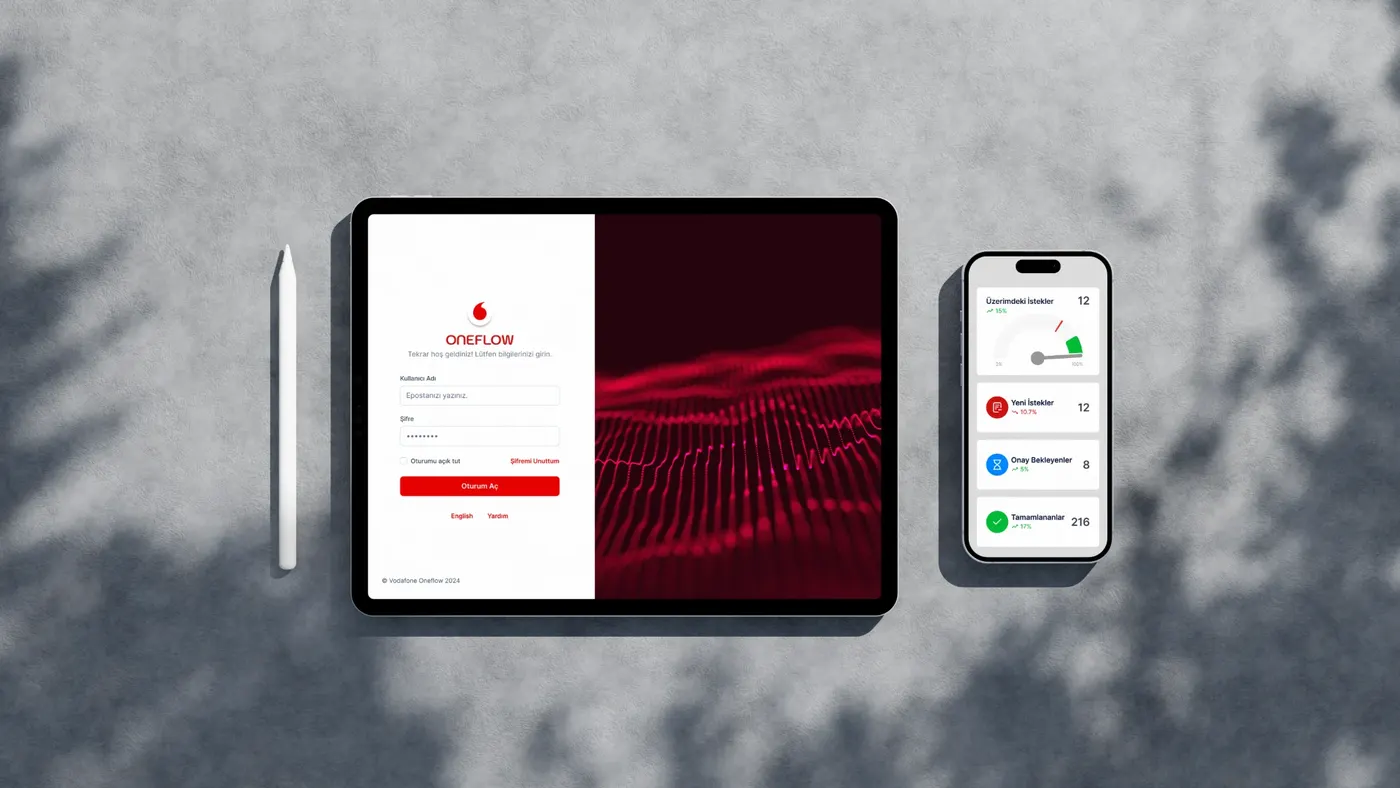
Vodafone OneFlow
From a system relearned with every request to a single order
OneFlow, which manages Vodafone employees' access and permission requests, held very different processes, from firewall access to Unix permissions. We rebuilt all of them on shared principles; each form kept its own information needs but came from the same parts and the same rules. When an employee meets a new type of request, they do not have to learn a new system.
View project
Related topics.
- You have a logo. What about your identity?What corporate identity guidelines are and what they contain.
- It does everything. Nobody can find it.Why clutter happens in panels and business software.
- Your product is good. Does it look that way?What to check in the product before going to market.
- When do you need a design system, and when is it unnecessary overhead?
- How do you redesign a digital product beyond a visual refresh?
It was good two years ago. What happened?
Assess your product