What a persona tells us #
A user persona is a fictional character based on research into a product’s audience. The Latin word persona referred to an actor’s mask and the character they played. In UX design, it describes characters representing different types of product users.
Nielsen Norman Group describes personas as concise, empathy-building accounts of users’ context, motivations, needs and ways of using a product. They help teams focus on what matters most to users and see decisions from their perspective.
A good persona gives meetings a shared language. Instead of projecting personal habits onto users, the team has a common research-based reference. Asking which persona’s problem a feature solves takes prioritisation away from personal preference.
Types of persona #
Nielsen Norman Group identifies three types of persona based on how they are created:
- Lightweight personas are created quickly from the team’s existing knowledge and assumptions. They provide a starting point but need research validation.
- Qualitative personas draw on patterns in user interviews and observations.
- Statistical personas add a large survey and statistical analysis to qualitative research.
According to the same source, the qualitative approach offers the best balance of effort and value for most teams. Very large organisations may benefit from statistical methods, while resource-constrained teams can begin with lightweight personas. For an early-stage startup, a lightweight persona is a useful starting point—as long as its assumptions are tested in the first user interviews.
Creating a persona step by step #
- Gather data. Interview users individually, review support records and analytics, and use a well-designed survey if needed.
- Find patterns. Group users with similar goals, behaviours and obstacles. Personas emerge from these groups.
- Decide how many personas you need. Most products need more than one, but choose a primary persona to guide design priorities.
- Define the persona. Record goals, needs, motivations, obstacles, tools and behavioural patterns. Add a name and brief description to make it concrete.
- Write scenarios. Place the persona in a specific context with a problem to solve. These scenarios become starting points for journey maps and screen flows.
- Share and update. Keep personas somewhere the team regularly sees, and review them as new research arrives.
In interviews, ask users to describe the last time they performed the task rather than invent ideas about the product. A step-by-step account of a specific experience last week is more reliable than an answer about what they might do in future.
The resulting document should fit on one page. A persona that can be read at a glance is opened and used in meetings. A long report often stays in a folder.
What belongs on a persona card #
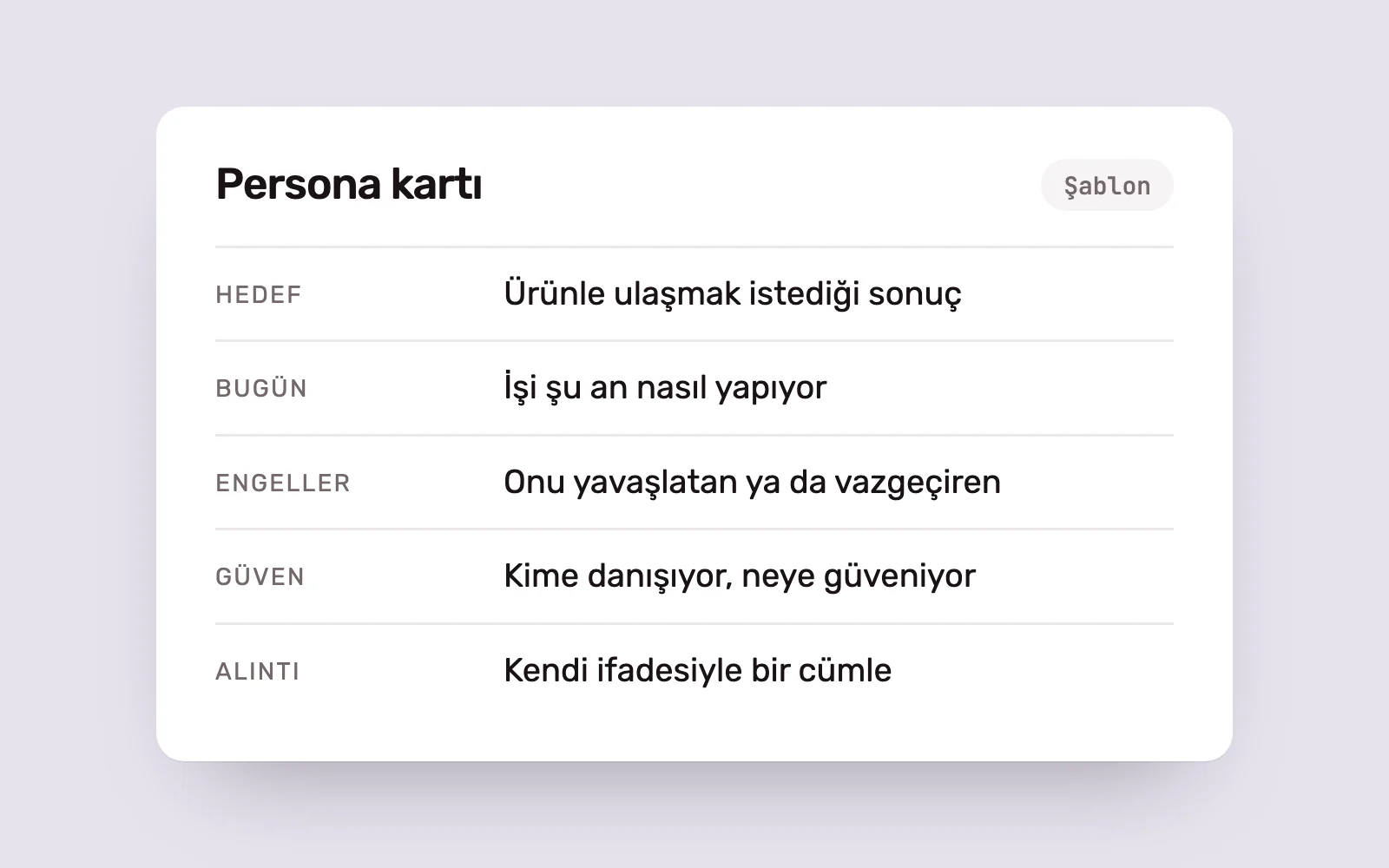
The format varies by project; there is no single correct template. Most useful cards include:
- The goal the user wants to achieve with the product, and the motivation behind it.
- How they do the task today, including the tools and methods they use.
- The obstacles, concerns and objections that slow them down or make them stop.
- Whom they consult and what they trust when making decisions.
- One or two short interview quotes in the user’s own words.
- Age, role, device and digital experience only where these affect the design.
We prefer a neutral image or illustration to a photograph of a real person. Stock photos can make teams associate a persona too strongly with a face, age or appearance. A persona’s value lies in explaining behaviour and needs, not looks.
Going beyond demographics #
A common weakness is a persona made up entirely of demographics. Knowing a user is in their thirties and shops twice a week is of little design value if you do not know what prevents a purchase or prompts action.
Nielsen Norman Group’s comparison of personas and jobs-to-be-done explains this well. Jobs-to-be-done focuses on the problem users want to solve and the outcome they seek. A well-researched persona includes the same information, with further behavioural and attitudinal detail. The article concludes that the two approaches are compatible.
In practice, this means putting the user’s task at the centre of the persona. Age, location and occupation belong only where they influence design. In a finance app, a person’s relationship with money and their concerns tell us far more than their year of birth.
AI and synthetic users #
AI-generated synthetic users and automated persona tools have become common in recent years. They can produce detailed personas and simulated interview responses in minutes.
Nielsen Norman Group takes a clear position: synthetic users cannot replace the depth and empathy gained from talking to real people, and often provide superficial or overly positive feedback. They can support desk research and hypothesis generation, but should not drive final decisions.
We use AI within those limits. It can help organise interview notes, find patterns or draft interview questions. The personas themselves are based on conversations with real users.
Common mistakes #
- Basing a persona on a team member or executive. Projecting our own habits onto users is an easy mistake.
- Creating too many personas. Ten separate personas make prioritisation difficult.
- Creating personas without speaking to users. Surveys help, but individual interviews provide richer information.
- Trying to fill in every detail immediately. Starting small and expanding with research is more efficient.
- Creating a persona and never opening it again. As the product and market change, personas need updating.
At Pars Design, we use personas alongside journey maps in new product and redesign work. The persona shows whom we are designing for; the journey map shows where that person needs support.
Sources #
- 3 Persona Types: Lightweight, Qualitative, and Statistical, Nielsen Norman Group; persona types and which teams they suit
- Personas vs. Jobs-to-Be-Done, Nielsen Norman Group; the relationship between personas and jobs-to-be-done
- Synthetic Users: If, When, and How to Use AI-Generated Research, Nielsen Norman Group; the limits of AI-generated synthetic users